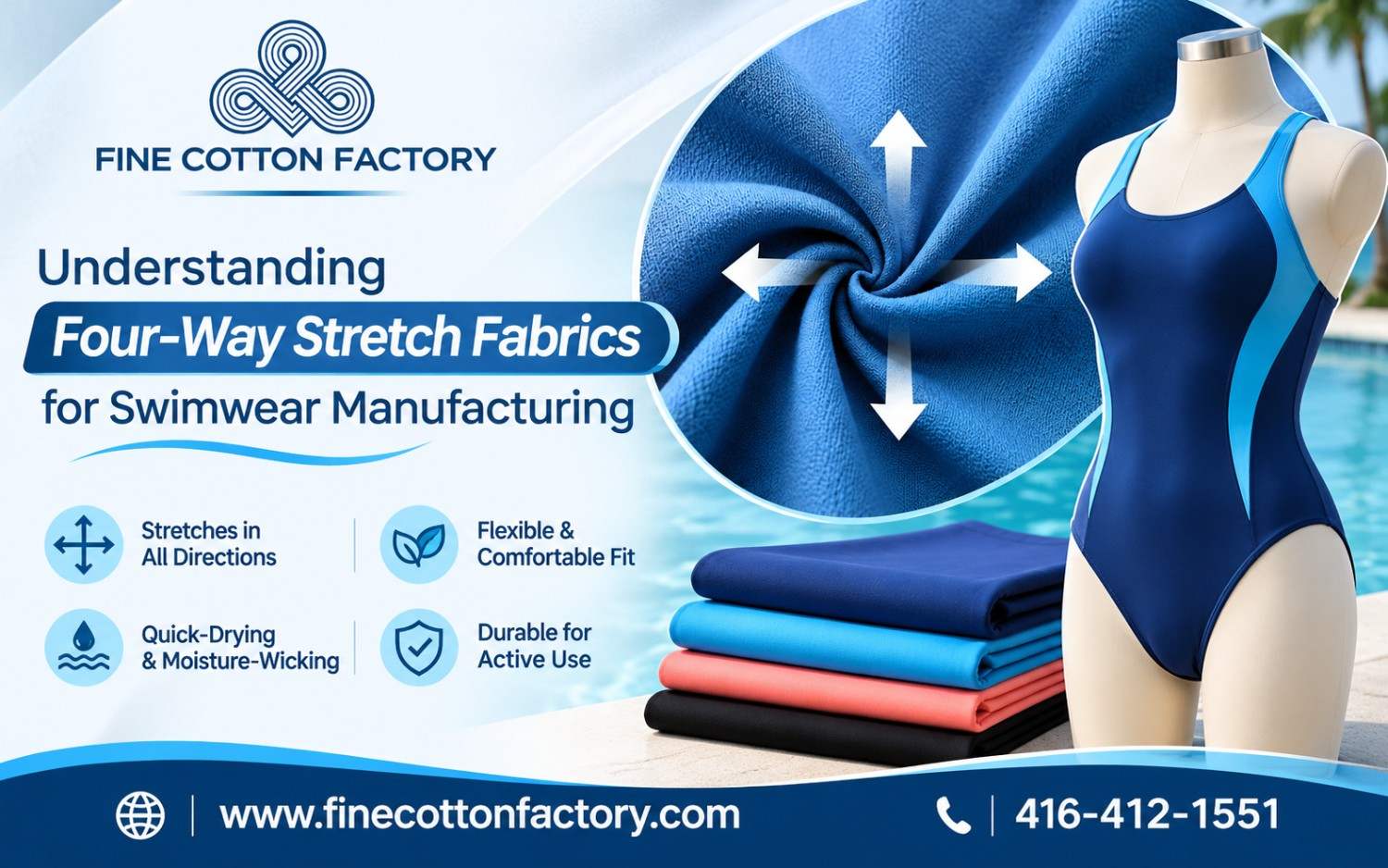
Understanding Four-Way Stretch Fabrics for Swimwear Manufacturing
Swimwear fabric needs to do more than stretch. It must move comfortably with the body, return to its original shape, stay supportive in water, and maintain its appearance after repeated exposure to chlorine, saltwater, sunlight, and washing.
This is where four-way stretch fabrics become particularly important in swimwear manufacturing.
Unlike fabrics that stretch in only one direction, four-way stretch materials extend both horizontally and vertically, giving designers greater flexibility when creating fitted swimsuits, bikinis, competitive swimwear, and active swimwear.
For brands working with swimwear fabric manufacturers, understanding how these fabrics are constructed, which fibres are used, and how stretch performance affects the finished garment can make material selection much easier.
What Is Four-Way Stretch Fabric?
Four-way stretch fabric is a textile that stretches in two directions: across its width and along its length. This allows the material to accommodate body movement from multiple angles while maintaining a close, comfortable fit.
In swimwear, this flexibility is particularly useful because garments need to move with the wearer during swimming, diving, stretching, and other water-based activities.
The term four-way stretch generally refers to two-way fabric extension across two axes, with the ability to stretch in both positive and negative directions.
A simple breakdown:
- Horizontal stretch: The fabric expands across its width.
- Vertical stretch: The fabric extends along its length.
- Stretch recovery: The material returns towards its original dimensions after being stretched.
The combination of these properties helps swimwear maintain its fit without restricting movement.
Why Is Four-Way Stretch Important in Swimwear Manufacturing?
Swimwear is designed to fit closely against the body, which means fabric performance directly affects comfort, coverage, and garment construction. A material that stretches well but fails to recover can become loose after repeated use.
Four-way stretch fabrics help manufacturers balance flexibility with the support required for fitted swimwear.
1. Better Freedom of Movement
Swimming involves continuous movement of the shoulders, arms, hips, and legs. Four-way stretch fabric accommodates these movements more naturally than a material with limited directional stretch.
This makes it suitable for:
- One-piece swimsuits
- Bikinis and two-piece swimwear
- Competitive swimming suits
- Surf and water sports apparel
- Performance swimwear and rash guards
2. Improved Fit and Shape Retention
A good swimwear fabric should stretch around the body without becoming permanently distorted. Elastic recovery helps the garment return towards its intended shape after movement.
This is particularly important around the waist, bust, leg openings, and shoulder straps, where consistent fit contributes to comfort and coverage.
3. Greater Design Flexibility
Four-way stretch allows designers to experiment with fitted silhouettes, curved seams, cut-outs, and body-contouring designs.
It also gives manufacturers more flexibility when developing garments with different levels of compression and support.
Understanding the Main Fibres Used in Four-Way Stretch Swimwear Fabrics
Not all four-way stretch fabrics offer the same performance. The fibre composition plays an important role in determining how a swimsuit feels, stretches, dries, and performs during regular use.
Two of the most common fibre combinations used in swimwear manufacturing are nylon-spandex and polyester-spandex.
- Nylon-Spandex Fabric
Nylon-spandex blends are widely used for fashion swimwear because they offer a soft feel, flexibility, smooth surface, and comfortable fit.
They are particularly suitable for bikinis, one-piece swimsuits, and premium swimwear collections where comfort and appearance are important.
- Polyester-Spandex Fabric
Polyester-spandex blends are often selected for their durability, colour retention potential, and suitability for performance-oriented swimwear.
They can be a practical choice for training swimwear, frequent pool use, and collections requiring greater resistance to chlorine-related degradation.
Nylon-Spandex vs Polyester-Spandex: Which Is Better for Swimwear?
Both combinations can work well in swimwear, but the right option depends on the garment’s intended use and performance expectations.
| Fabric characteristic | Nylon-Spandex | Polyester-Spandex |
| Fabric feel | Generally soft and smooth | Smooth, depending on construction |
| Stretch | Excellent potential | Excellent potential |
| Recovery | Depends on elastane and construction | Depends on elastane and construction |
| Colour retention | Depends on dyeing and exposure | Often preferred for chlorine-focused applications |
| Durability | Good with suitable construction | Good with suitable construction |
| Common applications | Fashion swimwear, bikinis | Training and performance swimwear |
An important consideration: Neither fibre combination automatically guarantees superior swimwear performance. Yarn quality, elastane selection, knitting structure, dyeing, and finishing all influence the final fabric properties.
What Makes a Four-Way Stretch Fabric Suitable for Swimwear?
Stretch alone is not enough to determine whether a fabric is suitable for swimwear. Manufacturers need to consider how the material behaves in wet conditions and after repeated exposure to different environmental factors.
Here are the main performance characteristics worth evaluating.
1. Stretch and Elastic Recovery
Stretch describes how far a fabric can extend when a force is applied. Elastic recovery describes how effectively it returns towards its original dimensions once that force is removed.
For swimwear, both properties matter. A fabric with good stretch but poor recovery may gradually lose its fit, particularly around high-tension areas.
2. Chlorine Resistance
Regular swimming pool exposure can gradually affect textile fibres and elastane. Chlorine-resistant swimwear fabrics are developed to help maintain their strength, elasticity, and appearance under repeated pool use.
Brands manufacturing training or competitive swimwear should pay particular attention to chlorine resistance when selecting materials.
3. UV Resistance
Swimwear is frequently exposed to direct sunlight, especially in outdoor pools and beach environments. UV exposure can contribute to colour fading and material degradation.
A suitable fabric should be evaluated for its ability to maintain performance and appearance under the expected conditions of use. UPF testing can also be considered when the garment is intended to provide UV protection.
4. Shape Retention and Dimensional Stability
A swimsuit should maintain its intended fit after swimming, drying, and washing. Dimensional stability helps reduce unwanted changes in fabric measurements.
Manufacturers should assess shrinkage, growth, and recovery rather than relying on the initial appearance of a fabric sample.
5. Opacity and Fabric Coverage
A fabric may look sufficiently dense when dry but become more transparent when stretched or wet. This can affect garment coverage and the overall quality of the finished swimsuit.
Testing the fabric under realistic stretch and wet conditions is therefore important, particularly for light colours and minimal-coverage designs.
The Role of Knitting Construction in Four-Way Stretch Fabrics
Fibre composition is only one part of swimwear fabric development. The knitting structure also influences how a material stretches, recovers, feels, and performs.
Circular knitting is particularly relevant because it allows manufacturers to develop stretchable knitted fabrics with different constructions and surface characteristics.
Some important considerations include:
- Knitted loop structure: Influences fabric flexibility, stretch behaviour, and surface appearance.
- Elastane integration: Affects elasticity, recovery, and fabric stability.
- Fabric weight (GSM): Influences coverage, thickness, and the overall feel of the swimsuit.
- Fabric density: Helps determine opacity, stability, and dimensional performance.
- Finishing processes: Can influence softness, surface feel, dimensional stability, and other performance characteristics.
A well-developed knitted structure helps create a fabric that balances flexibility, coverage, comfort, and durability.
How Much Elastane Should Swimwear Fabric Contain?
Elastane, also known as spandex or Lycra when referring to the registered fibre brand, is an important component of many four-way stretch swimwear fabrics. It provides the elasticity needed for close-fitting garments.
The appropriate elastane percentage depends on the desired stretch, recovery, compression, fabric construction, and intended application.
For example, a fashion bikini may prioritize softness and comfortable stretch, while performance swimwear may require a more supportive feel and controlled compression.
Rather than choosing a fabric based on elastane percentage alone, swimwear fabric manufacturers should evaluate:
- Fibre composition and yarn specifications.
- Horizontal and vertical stretch.
- Recovery after repeated extension.
- Fabric stability during wet use.
- Comfort and fit in the finished garment.
A higher elastane percentage does not automatically mean better swimwear fabric. The complete fabric construction determines how the material performs.
Choosing the Right Four-Way Stretch Fabric for Different Swimwear Applications
Different swimwear categories place different demands on the fabric. Understanding the intended application helps brands and manufacturers select materials that match their product requirements.
| Swimwear application | Important fabric properties |
| Fashion bikinis | Softness, stretch, recovery, colour appearance |
| One-piece swimsuits | Shape retention, coverage, flexibility |
| Competitive swimwear | Compression, recovery, low-drag construction where required |
| Surfwear and rash guards | Stretch, durability, UV protection requirements |
| Resort swimwear | Comfort, drape, colourfastness, appearance |
| Training swimwear | Chlorine resistance, durability, consistent fit |
The ideal material is not necessarily the one with the highest stretch. It is the one that delivers the right balance of performance, comfort, and appearance for the intended garment.
Common Mistakes to Avoid When Sourcing Swimwear Fabrics
Selecting swimwear fabric based only on its appearance or initial hand feel can create problems during garment production. A material that looks attractive on a sample may not perform as expected after repeated stretching, washing, or water exposure.
Here are some common sourcing mistakes worth avoiding:
- Ignoring recovery: Stretch without adequate recovery can lead to loose-fitting garments.
- Overlooking chlorine exposure: Fashion swimwear and regular training swimwear may require different durability considerations.
- Choosing GSM without considering construction: Fabric weight alone does not determine coverage or performance.
- Skipping wet testing: Some fabric issues only become noticeable when the material is wet.
- Ignoring colourfastness: Colour changes can affect the appearance and perceived quality of the finished product.
- Not testing the finished garment: Seams, lining, elastic, and construction can influence the overall fit and performance.
A proper sampling and testing process helps identify these issues before moving into bulk manufacturing.
How Should Brands Evaluate Swimwear Fabric Manufacturers?
Choosing the right swimwear fabric manufacturer involves more than comparing fabric samples and prices.
Brands need a manufacturing partner who understands the technical requirements of stretch fabrics and can maintain consistent quality throughout development and production.
Before finalizing a manufacturer, consider these factors:
- Experience with stretch fabrics
Look for manufacturers familiar with nylon-spandex, polyester-spandex, and other elastic knitted constructions.
- Custom fabric development
A capable manufacturer should be able to discuss custom GSM, fibre compositions, knitting structures, and fabric performance requirements.
- Sampling and prototyping
Fabric samples allow brands to evaluate stretch, recovery, opacity, hand feel, and suitability before committing to production.
- Quality-control capabilities
Ask about testing procedures for shrinkage, colourfastness, stretch recovery, dimensional stability, and other relevant performance characteristics.
- Production consistency
The manufacturer should be able to maintain agreed fabric specifications across repeat production batches.
A technically knowledgeable manufacturer can help brands avoid unnecessary material changes and make the transition from fabric development to garment production more predictable.
Frequently Asked Questions
1. What is four-way stretch fabric used for in swimwear?
Four-way stretch fabric is used for bikinis, one-piece swimsuits, competitive swimwear, rash guards, and other fitted water-based apparel. It stretches horizontally and vertically, allowing greater freedom of movement and a comfortable fit.
2. Which fabric is best for manufacturing swimwear?
Nylon-spandex and polyester-spandex are two popular choices. Nylon-spandex is often selected for its softness and comfortable feel, while polyester-spandex can be suitable for applications requiring greater chlorine resistance and colour retention.
3. Is four-way stretch better than two-way stretch for swimwear?
Four-way stretch generally offers greater multidirectional flexibility, making it useful for fitted swimwear. Two-way stretch may be suitable for certain designs, but the choice depends on garment construction and movement requirements.
4. Why is elastane important in swimwear fabric?
Elastane provides elasticity, helping swimwear stretch around the body and recover its shape after movement. It contributes to garment fit, flexibility, and support.
5. Does four-way stretch fabric lose its elasticity in water?
It can lose elasticity over time depending on fibre composition, elastane quality, chlorine exposure, UV radiation, and care practices. Swimwear fabrics should be selected and tested for their intended water-use conditions.
6. What GSM is suitable for swimwear fabric?
There is no single ideal GSM for all swimwear. The appropriate weight depends on the garment design, desired coverage, fabric density, fibre composition, and performance requirements.
7. Can four-way stretch fabrics be custom-developed?
Yes. Swimwear fabric manufacturers with suitable knitting and textile engineering capabilities can develop custom stretch fabrics by adjusting fibre blends, yarn specifications, fabric weight, knitting construction, and finishing requirements.
8. What should brands test before bulk swimwear fabric production?
Brands should consider stretch and recovery, dimensional stability, colourfastness, opacity when wet, chlorine resistance, and UV performance where relevant. Testing should reflect the intended application of the finished garment.
Developing Better Stretch Fabric Solutions with Fine Cotton Factory
The performance of swimwear begins long before a finished garment reaches the customer.
It starts with selecting the right fibres, understanding fabric construction, and developing materials that can handle the demands of regular use.
At Fine Cotton Factory, we bring more than 25 years of textile manufacturing experience, combining advanced circular knitting technology, in-house research and development, and custom textile engineering to develop premium knitted fabric solutions.
Our expertise in cotton, jersey, jacquard, performance, and specialized knitted fabrics supports businesses looking for quality-focused and application-specific textile development.
We understand that different products require different material properties, which is why fabric construction, functionality, and consistency remain central to our approach.
Whether your business is exploring stretch fabric development, specialized knitted structures, or custom textile solutions for new product categories, we focus on turning material requirements into practical manufacturing possibilities.
At Fine Cotton Factory, we believe better textile products start with better fabric development, technical understanding, and a manufacturing partnership built for the long term.